Community Highlights

These highlights feature efforts by the community that are bringing us closer to a modern vision for hydropower. Interested in featuring your project? Contact the Vision team.
Image
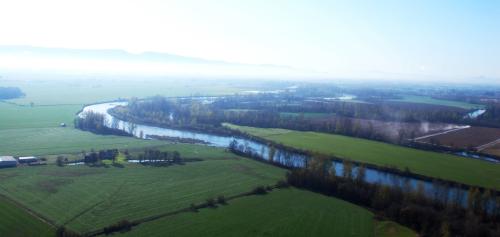
Aerial view of Willamette River
The Sustainable Rivers Program has helped determine environmental flow requirements on many rivers, including the Willamette River shown here. (Photo by U.S. Army Corps of Engineers)

Sustainable Rivers Program

Tags
Sustainable Development and Operations
Coordinated Operations
Sectors
Government
Other stakeholders

River infrastructure, such as locks and dams, alters water flow patterns in ways that can affect river species and habitats. The Sustainable Rivers Program is a collaborative effort between the U.S. Army Corps of Engineers and The Nature Conservancy to find sustainable ways to manage river infrastructure and water flows that maximize benefits to both people and nature. Specifically, the program helps determine environmental flow requirements for rivers—the water flow on either side of a dam necessary to support river species and habitats—and operating plans for infrastructure that use these flows. The program takes a collaborative approach that combines science and stakeholder engagement to review new environmental flow patterns and modernize river infrastructure. Since 2002, the Sustainable Rivers Program has grown to include 44 rivers and 90 associated reservoirs and dams. 

Learn more about the Sustainable Rivers Program from The Nature Conservancy and U.S. Army Corps of Engineers. 

Published on March 11, 2024
The optimized regulatory processes icon is a dark purple half gear on the left with lines and connectors moving out to the right.

Hydropower Regulatory and Permitting Information Desktop Toolkit (RAPID)

Tags
Optimized Regulatory Processes
Process Outcome Assessment
Sectors
DOE/National Labs
Other stakeholders

Navigating federal and state energy regulations and permitting can be a complicated process for developers and regulators, which can slow investments in energy projects. Launched in 2015, the Regulatory and Permitting Information Desktop (RAPID) toolkit is designed to help make it easier to navigate the regulatory processes for hydropower, geothermal, solar, and bulk transmission. Specifically, the free toolkit: 

  • offers easy access to permit applications, processes, and manuals
  • outlines regulatory requirements and clarifies the permitting process
  • provides best practices, case studies, and how-to information
  • facilitates communication among stakeholders

Since 2015, the toolkit has been accessed from all over the United States by users at federal agencies, universities, state and local governments, utilities and developers, and consultants. Hydropower stakeholders can also provide input to continue improving the toolkit over time and keep it updated. RAPID was developed by the National Renewable Energy Laboratory with funding from the U.S. Department of Energy Office of Renewable Energy and the Office of Electricity, with additional support from Tetra Tech, Environmental Management and Planning Solutions Inc., Kearns and West, and Herrick Solutions.

Check out the RAPID toolkit.

Published on March 11, 2024
The improved valuation icon is a bright purple line graph.

A Flexible Framework for Valuing Hydropower

Tags
Improved Valuation
Service Value Recognition
Sectors
DOE/National Labs
Other stakeholders

Economics is a key driver behind the mix of energy sources contributing to the U.S. electric grid. The market value of different energy sources—such as hydropower, solar, wind, or fossil fuels—can determine how competitive they are on the power market. But it is a challenge to accurately estimate the value of hydropower grid services because some of hydro’s key attributes—flexibility and reliability—aren’t included in traditional valuations. To better reflect hydropower’s value, researchers from the Electric Power Research Institute simulated different energy and operating scenarios in the Western Electric Coordinating Council (WECC) region, which encompasses the western United States and parts of Canada and Mexico. With funding from the U.S. Department of Energy to quantify the value of hydropower in the electric grid, this research established the many value streams available to hydropower and identified opportunities to better assess the value of the full range of services that hydropower provides.

To learn more, read the report and check out a summary from Hydro Review. 

Published on March 11, 2024