
Community Highlights

These highlights feature efforts by the community that are bringing us closer to a modern vision for hydropower. Interested in featuring your project? Contact the Vision team.
The optimized regulatory processes icon is a dark purple half gear on the left with lines and connectors moving out to the right.

Non-Powered Dam Toolkit Supports Streamlined Regulatory Review

Tags
Enhanced Collaboration, Education, and Outreach
Optimized Regulatory Processes
Sectors
DOE/National Labs
Industry

The Non-Powered Dam (NPD) Toolkit, released in October and developed collaboratively by INL and PNNL, compiles regulatory guidance and procedural information to assist stakeholders navigating non-powered dam hydropower development. The toolkit addresses permitting pathways, environmental compliance considerations, and stakeholder engagement processes, providing structured access to commonly requested regulatory information.

Early user feedback indicates that the toolkit improves clarity around regulatory requirements and supports more efficient project review discussions.
Non-Powered Dam Toolkit

Published on June 18, 2026
The improved valuation icon is a bright purple line graph.

PSH Cost Model Web App Supports Transparent Pumped Storage Cost Analysis

Tags
Advanced Technology
Improved Valuation
Sectors
DOE/National Labs
Industry
Other stakeholders

The PSH Cost Model Web App, hosted on OpenEI, provides an interactive framework for estimating the lifecycle costs of pumped storage hydropower (PSH) projects. Users can adjust site characteristics, design parameters, and financial assumptions to evaluate capital expenditures, operations and maintenance costs, and economic feasibility. The platform is designed to support structured cost discussions among developers, planners, and financing partners evaluating long-duration energy storage projects.

By increasing visibility into cost drivers and enabling standardized modeling approaches, the tool advances transparent economic analysis for pumped storage development.


NREL PSH Cost Model Web App

Published on June 18, 2026
The improved valuation icon is a bright purple line graph.

HydroBoost Enables Transparent Hydropower Valuation Modeling

Tags
Enhanced Collaboration, Education, and Outreach
Improved Valuation
Sectors
DOE/National Labs
Other stakeholders

HydroBoost, developed by Idaho National Laboratory and available through the INL Software Catalog, is a publicly accessible tool for evaluating hydropower project value streams. The platform supports scenario-based modeling of revenue potential, capacity value, and grid service contributions under varying market and operational assumptions. Users can modify financial and technical inputs to assess project economics across a range of deployment contexts.

By improving transparency in valuation analysis and clarifying hydropower’s service contributions to energy systems, HydroBoost supports more rigorous economic assessment and informed investment discussions.


INL Software Catalog – HydroBoost

Published on June 18, 2026
The improved valuation icon is a bright purple line graph.

Tool Calculates the Full Value of Pumped Storage Hydropower

Tags
Improved Valuation
Service Value Recognition
Sectors
DOE/National Labs

Accurately estimating the full value of pumped storage hydropower (PSH) is key to supporting future developments, but PSH provides both market and non-market services that can be difficult to quantify. To address this, Argonne National Laboratory led a multi-laboratory team to create the Pumped Storage Hydropower Valuation Tool. Developed with input from industry participants and guided by a technical advisory group consisting of industry experts and other stakeholders, the free tool provides valuation guidance that accounts for all grid services and contributions from PSH plants. Users of the tool are guided through the 15-step valuation process that features a back-end benefit-cost analysis tool, a price-taker valuation tool for small-scale PSH, and a multi-criteria decision analysis tool. There is also an accompanying guidebook that provides consistent, repeatable methods to more accurately value PSH projects and inform stakeholder decisions on future PSH investments.

Learn more about the PSH Valuation Tool from Argonne National Laboratory. 

Published on December 20, 2024
Image
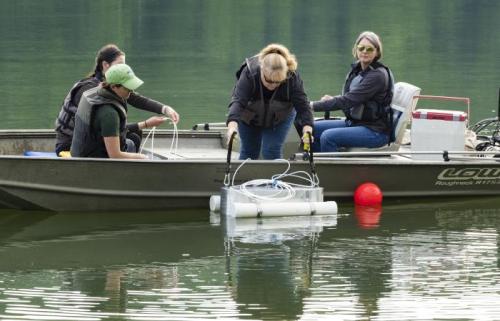
Researchers in a small boat deploy an instrument to collect emissions measurements.
Researchers deploy equipment to measure reservoir emissions. (Photo by Carlos Jones | Oak Ridge National Laboratory)

Measuring Greenhouse Gas Emissions from Hydropower Reservoirs

Tags
Sustainable Development and Operations
Climate Resilience
Sectors
DOE/National Labs

All inland bodies of water have some level of greenhouse gas (GHG) emissions resulting from microbes in the environment that naturally produce carbon dioxide and methane. Current estimates of GHG emissions from reservoirs are incomplete and vary widely, which makes it challenging to calculate total emissions related to hydropower operations. To better quantify and reduce reservoir emissions related to hydropower, researchers at Oak Ridge National Laboratory are using advanced tools to measure reservoir GHG emissions released through multiple processes, including degassing as water is passed through turbines. Warmer water temperatures in the future are expected to alter GHG emissions from reservoirs, but better understanding the current GHG emissions can improve models that inform reservoir management to mitigate emissions for climate resilience. 

Learn more from Oak Ridge National Laboratory. 

Published on December 19, 2024
Image
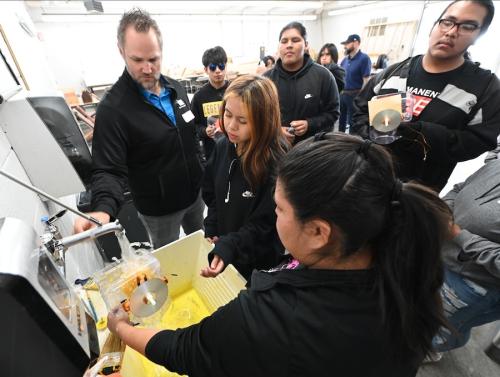
Students stand around a small model of a hydropower turbine.
During Hydro School, students built a model turbine. (Photo by Idaho National Laboratory)

Hydro School Reaches Students and Tribes in Idaho

Tags
Enhanced Collaboration, Education, and Outreach
Workforce Development
Sectors
DOE/National Labs

The future of hydropower is dependent on a well-trained, diverse workforce that is ready to meet industry needs. Hydro School, hosted by Idaho National Laboratory (INL), is one example of hydropower educational outreach that is key to workforce development. Sponsored by the U.S. Department of Energy’s Water Power Technologies Office, INL’s Hydro School summer camp engaged students from the Shoshone-Bannock Tribe to participate in a week-long program. The camp included two days in the classroom, one day in the field, and one day visiting a local hydropower plant, the Idaho Falls Power Hydropower Plant. Students learned about hydropower basics, technologies and applications, and potential career paths, and had opportunities to participate in open dialogue about the their perspectives on natural and cultural resources related to hydropower.  

Learn more about Hydro School. 

Published on December 13, 2024
The sustainable development and operations icon is a maroon fish next to a gear.

Advancing Hydropower Cybersecurity Using Artificial Intelligence

Tags
Sustainable Development and Operations
Safe and Secure Infrastructure
Sectors
DOE/National Labs

Modernizing the U.S. electric grid means integrating new technologies that are typically connected to the internet. This growing network of integrated systems and technologies—often called the Internet of Things—increases opportunities for security compromises, making cybersecurity a key focus for energy infrastructure, particularly hydropower facilities. 

A new tool developed by the National Renewable Energy Laboratory (NREL) aims to provide tailored cybersecurity for hydropower plants. The Cybersecurity Situational Awareness Tool for Hydropower (CYSAT-Hydro) is a data-driven, hardware-agnostic cybersecurity tool designed to protect facilities from becoming access points for hackers and malicious actors. The tool uses artificial intelligence to detect anomalies in technology networks, then sends detailed information about cyberattacks to hydropower operators in real time to help restore functionality post-cyberattack. 

Learn more about CYSAT-Hydro from NREL.

Published on December 9, 2024
The optimized regulatory processes icon is a dark purple half gear on the left with lines and connectors moving out to the right.

FERC Guidance on Tribal Participation During Environmental Reviews

Tags
Optimized Regulatory Processes
Process Understanding and Access
Sectors
DOE/National Labs

Navigating the hydropower regulatory process is challenging, and can become particularly complex for federally-recognized Tribes which are sovereign nations. In 2024, the Federal Energy Regulatory Commission (FERC) released clear guidance outlining the role of Tribes during the FERC environmental review process. The new guide highlighted FERC’s commitment to promoting a government-to-government relationship between FERC and Tribes, and specified how Tribes can engage with and participate in FERC’s review of proposed energy infrastructure projects on their land. According to the updated guidance, Tribes can become involved in the process at any time, but are encouraged to participate as early and often in the process as possible. Establishing clear guidance for Tribal participation in the FERC environmental review process directly contributes to improving understanding of and access to the hydropower regulatory process. 

Learn more from FERC.

Published on December 9, 2024
The sustainable development and operations icon is a maroon fish next to a gear.

Federal Incentives Program to Modernize Hydropower Facilities

Tags
Sustainable Development and Operations
Safe and Secure Infrastructure
Sectors
DOE/National Labs

The U.S. Department of Energy launched an incentives program for infrastructure improvements at hydropower facilities. The program, Maintaining and Enhancing Hydroelectricity Incentives—also referred to as Section 247 of the Energy Policy Act of 2005—was funded through the Bipartisan Infrastructure Law. It made over $550 million dollars available in 2024 to eligible hydropower facilities to invest in infrastructure enhancements that increase grid resilience (including the addition of energy storage capacity), advance dam safety, or support environmental improvements. Through this incentive program, 293 hydropower facilities across 33 states received funding to improve their facilities. The effort directly supports the safety, security, and functionality of hydropower facilities throughout their lifetime, including modernizations necessary for hydropower to continue providing valuable services. 

To learn more, visit the program website. 

Published on December 9, 2024
The improved valuation icon is a bright purple line graph.

Price Formation in Zero-Carbon Electricity Markets

Tags
Improved Valuation
Service Compensation
Sectors
DOE/National Labs

Appropriately valuing hydropower’s contribution to the grid as energy markets evolve is key to justifying future hydropower investments and operations. The move towards clean energy technologies that do not have a direct fuel cost means that future electricity markets will be dominated by frequent, extended periods of low to zero electricity prices. Such unpredictable energy markets could make it prohibitively risky to develop new energy generation in the future. A report by Argonne National Laboratory and Pacific Northwest National Laboratory investigated the role of hydropower resources in future zero-carbon markets to set the stage for discussions about alternative electricity market mechanisms. Specifically, the report highlighted how generators could be compensated for relatively low-cost hydropower energy and found that hydropower was likely to benefit in a zero-carbon system by providing flexibility and energy storage in systems with high percentages of variable renewable resources. 

Learn more and read the report, “Price Formation in Zero-Carbon Electricity Markets: The Role of Hydropower.”

Published on July 15, 2024